

We all sense that groups can be more than the sum of their parts. Whether it’s a team, family, or community, something unique happens when individuals connect at a deeper level—possibility expands, trust grows, and new solutions emerge. Yet, group dynamics are often tangled with unspoken history, hidden tensions, and unconscious loyalties. We see this regularly, and we believe unlocking collective power asks for more than just communication skills or motivation speeches.
Integrative constellations open a different door—they surface what lies beneath, reveal hidden patterns, and invite wholeness into the group field.
Understanding integrative constellations
First, what are integrative constellations in the context of group work? Rather than focusing on individuals in isolation, this process places the group “system” at the center. Each member symbolically represents a part of the whole—a person, a value, a goal, sometimes even an obstacle. Through experiential methods, the invisible connections and blockages that shape group behavior become visible.
The power of a constellation is not in its theory, but in its direct experience of relationship and belonging.
For example, a team struggling with trust might discover that one member unconsciously carries the burden of a past failure, while another stands at the periphery, excluded by old dynamics. When these patterns surface, new movement becomes possible. Judgment fades. Empathy grows. Collaboration has room to breathe.
Why group potential remains locked
In our work with diverse groups, we notice that good intentions alone rarely unleash potential. Old patterns repeat until someone is willing to look beneath the surface. Common obstacles include:
- Unresolved conflicts: Silent tensions or past disappointments can insulate group members against genuine connection.
- Unclear boundaries: Roles get blurry, responsibility becomes diffuse, and decision-making falters.
- Lack of voice: Some members withdraw or over-adapt, while others dominate, limiting the flow of ideas.
- Inherited patterns: Groups inherit habits from prior experiences, cultures, or leadership that no longer serve their present goals.
Group potential is about more than motivation—it's also about the structure of relationships and the stories that live between people.
What actually happens in an integrative constellation?
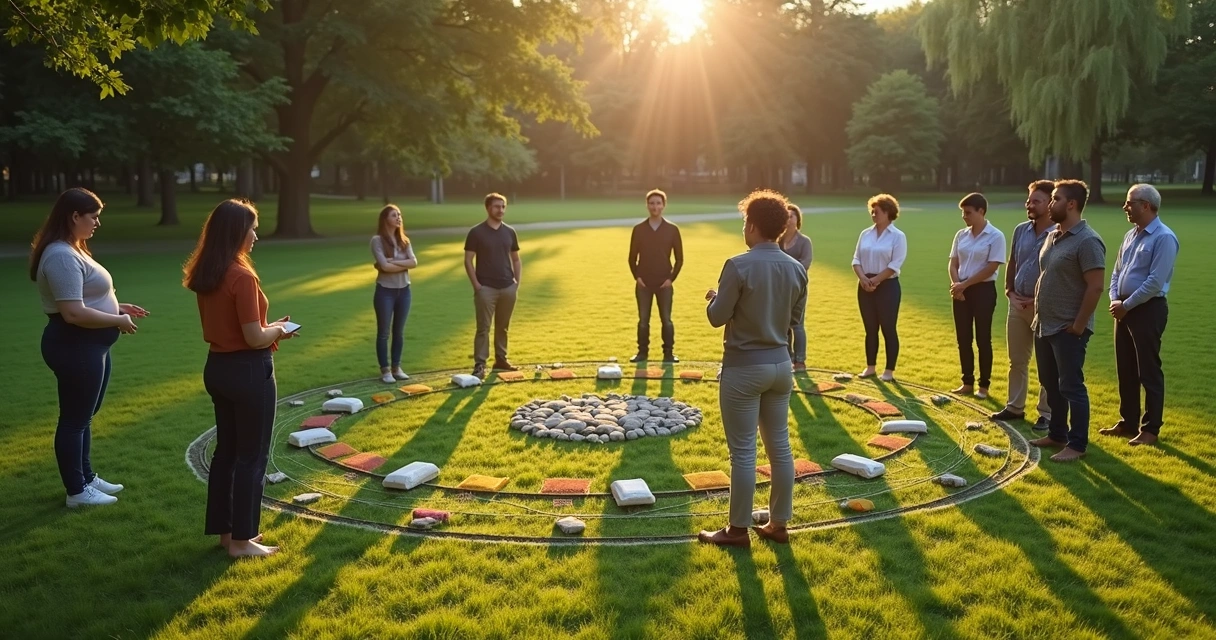
The process is experiential. It’s not a lecture, not a debate. The facilitator gathers the group, clarifies the focus (such as a persistent challenge or aspiration), and invites participants to represent different group elements. These could be people, projects, ideals, or even external factors. Sometimes, objects or pieces of paper stand in for key energies or perspectives.

Representatives “step into” their roles and share what they notice—their emotions, physical sensations, new impulses, or shifts in perspective. This is not about performance but about trusting what arises. The facilitator moves elements, asks questions, or introduces statements to support new understanding. Over time, a new order often emerges. Members might notice, “I feel seen for the first time,” or “It’s easier to forgive,” or simply, “Now our next step is obvious.”
Transformation happens when the invisible becomes visible.
Randomized controlled trials, like those conducted at University Hospital Heidelberg, have demonstrated that group constellations foster improvements in feelings of belonging, confidence, and psychological functioning. (Significant improvements in social systems, enhancements in psychological functioning).
Principles that unlock potential
Integrative constellations stand on a few key principles that, in our view, shift the group field for the better. These are not dogmas but patterns observed in healthy systems:
- Belonging: Every member has a place, regardless of history or hierarchy. Marginalizing anyone—even in subtle ways—weakens group coherence.
- Order: Clear roles, respect for what came before, and recognition of different contributions bring a sense of stability.
- Exchange: Giving and taking occur in balance. Chronic over-giving or withholding, whether of time, energy, or recognition, eventually breeds frustration.
- Responsibility: Individuals own their choices. Blame shifts to shared agency.
When groups align with these principles, new energy enters. We’ve witnessed teams move through deadlocks, families resolve longstanding rifts, and organizations renew their sense of shared purpose.
These principles act as pathways for growth and authentic collaboration, not as rigid rules.
Applying integrative constellations in different contexts
The method adapts well to a range of collective settings. In organizations, we’ve used it with leadership teams challenged by rapid change. In schools and communities, it brings clarity to issues like inclusion or generational conflict. The process can illuminate:
- Unspoken values or mission conflicts
- Hidden alliances or resistance to change
- Decision-making bottlenecks
- Patterns of burnout or disconnection
In therapeutic group work, constellation approaches—supported by evidence from a meta-analysis of systemic therapy—demonstrate effectiveness in addressing a range of psychological and relational challenges.

Couple and family constellations, for example, have been shown to improve relationship quality and collective efficacy, affirming the value of systemic work in improving how people relate and cooperate. (systemic couple therapy effectiveness).
Stories from the field
It’s one thing to read the theory—quite another to witness change happen in real time. In one organization, a senior leader repeatedly clashed with a newly hired manager. Standard mediation stalled. Through a constellation, it became clear that the new manager inadvertently carried the “outsider” role, unconsciously echoing the founder who once disrupted the status quo. Once recognized, the group could reposition, and trust started to build. The source of conflict was not just personality, but history seeking new expression.
In a community initiative, younger members felt unheard despite their ideas. During the constellation, the “voice of innovation” was physically distant in the circle. As the process progressed, the group turned toward this representative, listened, and included the new perspective. Afterwards, projects moved forward with more engagement and less friction.
These moments are not magic. They are the product of a method that invites honesty, humility, and the courage to see the system as it is.
Growth as a process, not an event
Unlocking group potential is not about a single breakthrough. It is a process—one that blends awareness, accountability, and connection. Integrative constellations give groups a living map. Patterns once hidden can be named, honored, and sometimes released. As groups realign, energy that was tied up in conflict or confusion becomes available for creativity and progress.
The group heals as each voice finds its place.
When the collective finds flow, new solutions seem to arise effortlessly. A sense of possibility returns. The group's potential, long dormant, becomes tangible.
Conclusion
We find that unlocking group potential through integrative constellations is about bringing unseen patterns into the light, giving every member a place, and allowing new possibilities to emerge in the space between us. When old stories lose their grip, groups reclaim their capacity for connection, innovation, and shared purpose. Backed by research and lived experience, this process offers something rare—a path to wholeness, not just for individuals, but for teams, families, and communities as a whole.
Real transformation does not come from fixing people, but from healing the field that holds them together.
Frequently asked questions
What is an integrative constellation?
An integrative constellation is a group process that brings hidden patterns and dynamics within a collective—such as a team, family, or organization—into view by inviting members to represent various roles or elements and interact in a guided, experiential way. This makes it possible to sense and shift the forces shaping group behavior, leading to deeper understanding and new ways of relating.
How do group constellations work?
In a group constellation session, participants or objects represent people, values, or issues that are central to the group’s concern. The facilitator invites representatives to move and speak from their embodied perceptions, allowing the group to experience what is typically out of awareness. Through guided steps and sometimes healing statements, the system can find new balance or insight.
Is it worth it to try constellations?
Studies—including those from major universities—show that constellation methods support improvements in well-being, social connection, and psychological functioning. Many people report renewed clarity, relief, and stronger relationships. As with any approach, each person’s experience will be unique, but the research and feedback are encouraging.
How can I join a constellation session?
You can take part in a constellation session by joining a group workshop or, in some cases, by arranging one within your organization or community. Sessions may be in person or online, and are usually facilitated by someone trained in the method. Bringing an open mind and respect for the process helps you and the group benefit most.
What are the benefits of group constellations?
Group constellations invite more empathy, trust, and collaboration by making unconscious group patterns visible and open for transformation. Participants often feel a stronger sense of belonging, make progress on stuck issues, and experience deeper connection to the group’s shared purpose. Research supports gains in social functioning, confidence, and relationship quality.