


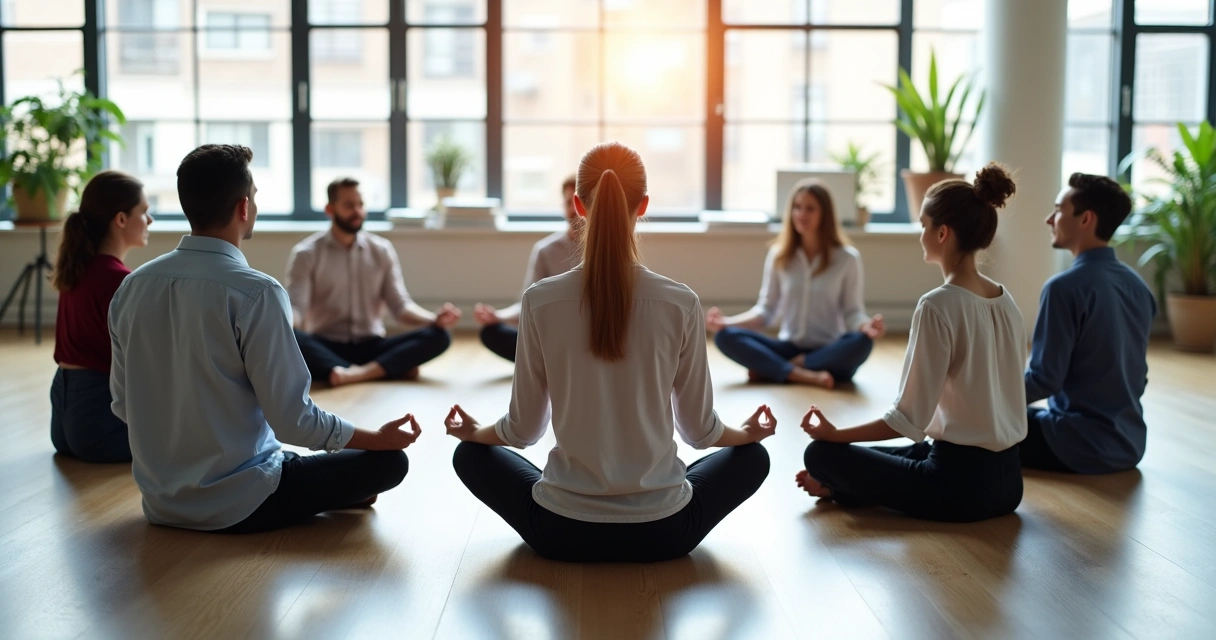
We have seen a steady rise in group meditation across organizations in recent years. Meditation is often linked with personal health, stress reduction, or private moments of stillness, but when practiced together in a work context, its impact reaches far beyond the individual level. While some benefits are easy to imagine, like feeling more relaxed or less tense by the end of the day, many others sit quietly in the background, making substantial changes in ways we might not expect.
It is these often-overlooked outcomes we want to highlight: the silent shifts in organizational culture, the enhancements in relationship dynamics, and the formation of resilient mental habits among teams. Here, we share ten distinct benefits of group meditation in organizations that usually fly under the radar—yet, in our opinion, may offer some of the deepest value.
What makes group meditation different?
Before diving into the list, we think it is useful to clarify why group meditation in workplaces is a unique experience. Meditating alone is a deeply personal journey. In a group, though, something different emerges—a shared field of intention, accountability, and silent support that changes not just the individual, but the group as a whole. This setting creates opportunities for collective insight, empathy, and coordinated growth that simply don’t exist in isolation.
The often-overlooked benefits of group meditation
1. Real bonding beyond daily tasks
Group meditation peels away the surface of daily roles and responsibilities. We see colleagues not just as emails in our inbox, but as people sharing a common experience. Over time, these moments build a type of trust that can survive outside pressures or misunderstandings that sometimes arise at work.
A silent room can reveal more than a thousand words.
2. Fewer misunderstandings and better communication
In our work with teams, we’ve noticed a subtle shift: after regular group meditation, people are more likely to pause before reacting, listen more attentively, and pick up on nonverbal cues. This doesn’t just help with managing conflict; it prevents many disagreements from escalating in the first place.
3. A grounded response to high-pressure moments
When an entire team has trained together to stay calm and focused, the group as a whole responds to pressure with steadiness. The result is that tough situations are met with clarity rather than chaos. Teams often report fewer heated moments and a surprising sense of cohesion under deadlines or during crises.
4. Releasing unspoken group tension
It’s easy for tension to build up under the surface: unexpressed worries, silent frustrations, shared anxieties. Group meditation acts as a form of “emotional cleanup,” giving space for this collective tension to ease. We find people become more open to feedback and less guarded in sharing their views, which makes the office atmosphere lighter and more genuine.
5. Inspiring creative thinking as a team
Stillness often opens the door to new ideas. When people meditate together, barriers between hierarchical levels or roles fade away, and team members are more likely to suggest fresh solutions or make connections between ideas. This group openness can catalyze a flow of creativity that is hard to spark through meetings alone.
6. Lowered collective stress baseline
While individual meditation is known for reducing stress, group meditation creates a new shared “normal” within teams. Over weeks, people describe a collective sense of “reset”—less irritability, faster recovery after setbacks, and greater patience, even during challenging rolls of the workday.
7. Strengthened sense of shared purpose
Sometimes, teams lose sight of why they are together at all, especially when routines take over. The practice of coming together for meditation, even if brief, is a reminder of shared goals and mutual respect. We have noticed that teams with such practices show more alignment and resilience in projects that require collective effort.
8. More inclusion and breaking down barriers
Meditation does not require any specific background, role, or status. When a group gathers to practice together, usual workplace divisions—by position, language, or department—start to soften. We have seen quieter voices become more comfortable participating, and leaders becoming more approachable in the eyes of their teams.
9. Sharper and more stable attention spans
The work landscape is full of distractions. Group meditation helps anchor attention, not just for individuals but across entire teams. People report fewer interruptions in flow, greater ability to focus on the task at hand, and shorter recovery time after breaks or meetings.
10. Creating a mindful organizational culture
Group meditation, practiced over time, does not just stay inside the quiet room. It seeps into emails, meetings, and everyday interactions. We believe it plants the seeds for a culture that values awareness, kindness, and intentional action, making the workplace more humane—from the inside out.

How group meditation supports organizational growth
When organizational change depends only on policy, training, or performance reviews, results tend to stay on the surface. Practices like group meditation work at a deeper level—they influence mindsets, group norms, and provide immediate feedback to participants. The changes ripple outward: what starts in a quiet group circle often ends up reflected in the quality of decisions, relationships, and outcomes that matter over the long term.
It’s a difference we notice in how people carry themselves, how disagreements are smoothed, and even how creatively risks can be taken. Staff turnover decreases, workplace satisfaction climbs, and teams report a real sense of belonging.
Starting a group meditation practice in your organization
We recommend beginning with a simple approach. Open with a brief, voluntary session—no need for expert teachers or complicated techniques at first. Over time, invite feedback, adapt the timing, and make the environment comfortable for all. Importantly, the intention behind the practice should always be inclusion and awareness, not performance or measurement.
Be patient, and let the benefits build. What starts as a quiet experiment may become a cornerstone of your team’s wellbeing and resilience.
Conclusion
Group meditation has the potential to transform more than the way we feel at work. Its effects run underneath the obvious, creating a base for trust, innovation, and stability within organizations. We have seen these shifts happen slowly, quietly, but with unmistakable impact. If you’re looking for ways to support your team beyond traditional methods, group meditation is a practice that deserves serious attention.
Frequently asked questions
What is group meditation in organizations?
Group meditation in organizations means employees gather together to practice mindfulness, stillness, or guided breathing as a group, within the workplace. It can be as simple as a few minutes of collective quiet or a set program led by a facilitator.
How can group meditation help employees?
Group meditation offers employees a shared space to reset, reduce stress, and regroup as a team. Over time, it can support better mental health, encourage communication, and help people foster a sense of belonging and inclusion.
Is group meditation worth it for companies?
Yes, many organizations discover measurable improvements after starting group meditation, including lower employee stress, better teamwork, and greater creativity. We find that group meditation brings lasting value by supporting both personal and cultural transformation at work.
What are common benefits of group meditation?
Common benefits include reduced stress, clearer communication, increased empathy, higher group morale, and improved focus. It also encourages greater inclusion, trust among colleagues, and a more positive organizational atmosphere.
How to start group meditation at work?
To start group meditation at work, invite interested employees, choose a regular time, and designate a quiet space. Begin with short sessions (5–10 minutes), use a simple format or guided audio if needed, and encourage voluntary participation for best results.