


We often think confusion lives inside one problem. In our experience, it rarely does. A hard choice at work may connect to family pressure. A tense relationship may link to old roles we still carry. A drop in motivation may reflect a conflict between values, habits, and unmet emotional needs.
Systemic mapping is a simple way to see how parts of our life affect each other.
Instead of asking, “What is wrong with me?” we ask, “What is happening around me, within me, and between these parts?” That shift can change everything. It brings less blame and more understanding.
Many of us have had this moment. We sit with a notebook, trying to solve one issue, and after a few lines we notice three more. It can feel messy. But the mess is not failure. It is information.
What systemic mapping means
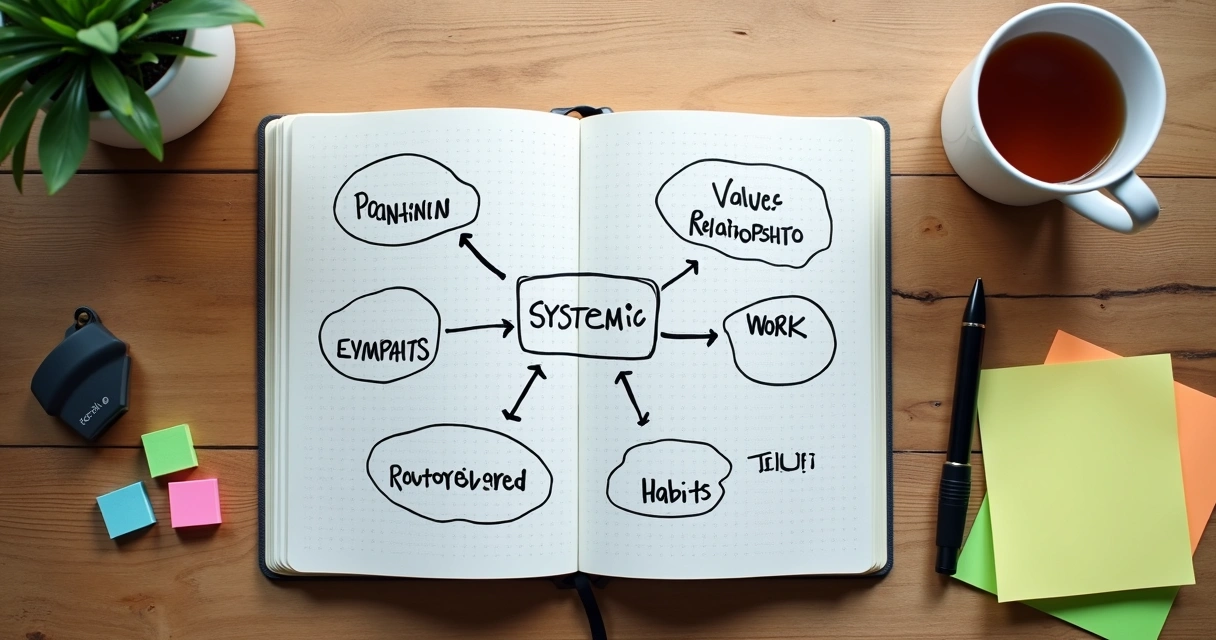
Systemic mapping is the practice of laying out the elements that shape our current experience. We make visible the people, roles, events, emotions, beliefs, and patterns involved in a situation. Then we look at the links between them.
This is not about making life mechanical. It is about seeing life with more honesty. When we map a system, we stop looking only at isolated facts.
- We identify key relationships.
- We notice repeated tensions.
- We track where energy rises or falls.
- We spot hidden loyalties and conflicting needs.
That is why systemic mapping helps with personal clarity. It turns vague discomfort into visible structure.
Clarity begins when patterns become visible.
This also connects with what research on self-concept clarity describes as having self-beliefs that are clear, stable, and internally consistent. When we cannot see our internal and relational patterns, our sense of self often feels scattered too.
When systemic mapping can help
We do not need a major crisis to use this method. In fact, it works well before things get worse. We think it is especially helpful when life feels full but unclear.
Some common situations include:
- Difficulty making a decision
- Repeated conflict in close relationships
- Feeling stuck in the same emotional reaction
- Confusion about purpose or direction
- Tension between personal values and daily choices
One person may map a career shift. Another may map a family conflict. Someone else may map why rest feels guilty instead of peaceful. The topic changes. The principle stays the same.
What goes into a personal map
A beginner does not need a complex model. We can start with a blank page and a few honest categories. The goal is not artistic beauty. The goal is truth we can work with.
A basic personal systemic map can include:
- People who affect the issue directly
- Current roles, such as parent, partner, leader, child, or caregiver
- Emotions that appear often
- Beliefs or phrases we repeat to ourselves
- Past events that still shape present reactions
- Needs that are met, ignored, or in conflict
- Places where we feel tension, peace, fear, or strength
A good map does not simplify life too much, but it makes life readable.
How to create your first map
We suggest a slow and direct process. If we rush, we may produce a neat page that says very little. If we stay honest, the page may look rough but become useful.
Here is a simple sequence that works well for beginners.
- Choose one issue. Write a clear sentence about it.
- Place that issue in the center of the page.
- Add the people, roles, and factors linked to it.
- Draw lines between what influences what.
- Mark each connection with a word, such as fear, duty, love, resentment, hope, or confusion.
- Circle what feels strongest right now.
After that, pause. Look before judging. We have seen people realize in five minutes that their “time problem” was actually a boundary problem, or that their “motivation problem” was grief that had never been named.
The first value of mapping is not solving. It is seeing.
What to look for in the map
Once the page is filled, we can begin reading it. This is where personal clarity starts to deepen. We are no longer staring at one emotion. We are observing a living pattern.
Pay attention to signs like these:
- One person or role takes too much space
- The same emotion appears in many areas
- A belief from the past controls a present choice
- Two strong needs oppose each other
- There is a missing element, such as rest, support, or truth
Sometimes the strongest insight comes from what is absent. We may map demands, duties, and expectations, then notice there is no place for joy. That absence speaks loudly.
Studies presenting the Momentary Self-Concept Clarity Scale also support the idea that clarity can shift over short periods. That matters. It means our inner sense of coherence is not fixed. It can change with awareness, reflection, and self-regulation.
Common mistakes beginners make
We have seen a few patterns that make mapping less helpful. The good news is that they are easy to correct.
First, many people try to map everything at once. That usually creates noise. Start with one question. Second, some people write what sounds acceptable instead of what feels true. A map built for appearance will not help much. Third, people may turn the map into a court case, trying to prove who is wrong. That narrows vision.
It helps to avoid these habits:
- Forcing quick answers
- Ignoring bodily reactions while mapping
- Writing only facts and leaving out emotions
- Making the map once and never reviewing it
Honesty makes the map work.

How mapping leads to personal clarity
Personal clarity is not just knowing what we want. It is knowing what pulls us, what splits us, and what aligns us. Systemic mapping supports that process because it helps us see structure under emotion.
When we map well, we may notice:
- Which conflict belongs to the present and which belongs to the past
- Which choices come from fear and which come from conviction
- Which relationships support growth and which keep old roles in place
- Which daily patterns weaken our inner stability
That kind of clarity feels different. It is quieter. More grounded. We stop chasing random fixes and begin making cleaner choices.
Conclusion
Systemic mapping gives us a way to slow down and see our life with more order and less confusion. It does not remove pain by itself. It does, however, reveal where pain connects, where energy is trapped, and where change can begin.
We think that is why this practice feels so direct. It respects complexity without surrendering to it. A page, a question, and honest observation can uncover more than many rushed attempts at self-explanation.
When we can see the system clearly, we can relate to ourselves with more maturity and choose with more steadiness.
Frequently asked questions
What is systemic mapping for beginners?
Systemic mapping for beginners is a simple way to organize the factors involved in a personal issue. We place the issue at the center, then map the people, emotions, beliefs, roles, and events linked to it. This helps us see patterns instead of only isolated problems.
How can I start systemic mapping?
We can start with paper and a pen. Pick one issue, write it in the center, and add the related elements around it. Then connect them with lines and short labels that describe the kind of influence involved, such as fear, pressure, care, duty, or hope.
Is systemic mapping worth doing?
Yes, especially when we feel mentally crowded or emotionally stuck. Mapping can reveal hidden links between present struggles and deeper patterns. Even one session can bring a clearer view of what needs attention first.
What tools do I need for mapping?
We only need very basic tools. A notebook, blank paper, sticky notes, or a digital drawing app can work well. The method matters more than the format. What helps most is having enough space to see connections clearly.
How does mapping improve personal clarity?
Mapping improves personal clarity by showing how thoughts, emotions, relationships, and past events interact. Once we can see those links, we make better sense of our reactions and choices. This creates a more stable and coherent understanding of ourselves.